
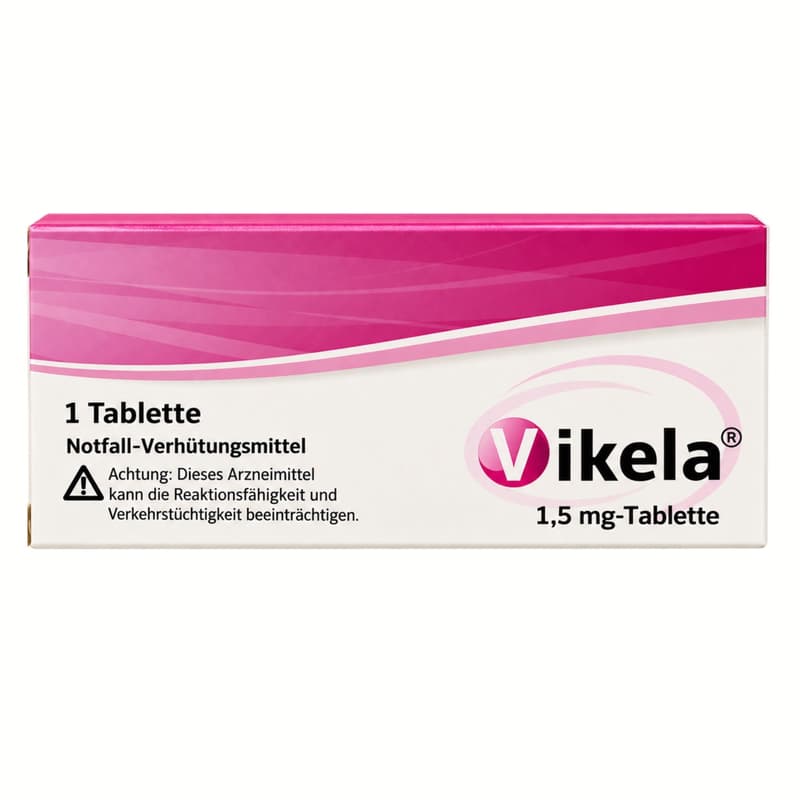
Vikela 1,5 mg Tabletten
Vikela is an oral emergency contraceptive tablet with 1.5 mg levonorgestrel, used to prevent pregnancy after unprotected sex. The round white tablet should be taken as soon as possible, no later than 72 hours afterwards, and swallowed whole with water. This pharmacy product contains lactose monohydrate and comes in a quantity of 1 pc.
Dies ist ein Arzneimittel. Zu Risiken und Nebenwirkungen fragen Sie Ihren Arzt oder Apotheker. Wir stehen Ihnen gerne unter (+43 (1) 343 43 53) oder per E-Mail (gurkerl@beavit.at) zur Verfügung.
Similar products





Description

The Vikela® 1.5 mg tablet is used for emergency contraception to prevent pregnancy after unprotected sexual intercourse. It should be taken within 72 hours of intercourse.
Important notes: Your health and well-being are important to us. That is why we ensure safe use and personalized advice. After placing your order, you will receive a personal email with a few questions regarding correct usage. Please answer these as soon as possible so that we can process and dispatch your order promptly.
Usage
What is Vikela and what is it used for?
Vikela is an oral emergency contraceptive.
What is emergency contraception?
Emergency contraception is a backup method to prevent pregnancy after unprotected sexual intercourse or contraception failure.
When can emergency contraception be used?
This method of contraception should be used as soon as possible after unprotected sexual intercourse or the failure of a contraceptive method: preferably within 12 hours, but in no case later than 72 hours (= 3 days) afterwards. It is more effective the sooner it is taken after unprotected intercourse. Vikela can only prevent pregnancy if taken within 72 hours of unprotected sexual intercourse. It does not work if you are already pregnant. If you have unprotected sexual intercourse again after taking Vikela, it will not prevent pregnancy.
Vikela has been shown to prevent 52% to 85% of expected pregnancies.
If you fear pregnancy for any of the following reasons:
- if you had sexual intercourse without contraception;
- if you forgot to take the "pill" on time;
- if your partner's condom tore, slipped, or came off;
- if you are concerned that your intrauterine device ("coil" / IUD) has been expelled;
- if your diaphragm or cervical cap slipped or was removed too early;
- if you fear that timely withdrawal during intercourse ("coitus
interruptus") or the calendar method failed;
- after rape.
Vikela works by preventing your ovaries from releasing an egg. It cannot prevent
the implantation of a fertilized egg in the uterus.
This tablet should only be used as an emergency method of contraception and not as a regular contraceptive method, as it is less effective than conventional hormonal contraceptives ("the pill").
Vikela is not indicated for use before the first menstrual bleeding (menarche).
What do you need to consider before taking it?
What should you consider before taking Vikela?
Vikela must not be taken,
- if you are allergic to levonorgestrel or any of the other ingredients of this medicine listed in Section 6.
Warnings and precautions
The use of Vikela is not recommended in the following cases:
– if you have ever had an ectopic or tubal pregnancy,
– if you have ever had an inflammation of the fallopian tubes (salpingitis),
– if you know that you or your relatives have risk factors for developing
thrombosis (blood clots),
– if you suffer from a severe digestive disorder that impairs the absorption of
food and medication into the body,
– if you suffer from severe liver impairment or a severe disease of the
small intestine (e.g. Crohn's disease).
A previous ectopic pregnancy or inflammation of the fallopian tubes increases the risk of a recurring ectopic pregnancy. If you have a history of
ectopic pregnancy or inflammation of the fallopian tubes, you should therefore consult your doctor before taking Vikela.
Emergency contraception should only be used occasionally. It is not a substitute for a regular
contraceptive method, because:
- it cannot prevent pregnancy in every case;
- there is a risk of hormone overdose, which can cause menstrual cycle
disorders;
Emergency contraception does not interrupt an existing pregnancy.
If you have had unprotected sexual intercourse more than 72 hours ago during the same menstrual cycle,
fertilization may have already taken place. In this case, taking Vikela after
another intercourse may not prevent
pregnancy.
Vikela should not be used multiple times during the same menstrual cycle, as this can lead to
cycle disturbances.
Vikela is less effective than regular methods of contraception. Your doctor can advise you on long-term contraceptive methods that are more effective at protecting you from pregnancy.
After taking this medicine:
You must take a pregnancy test to rule out pregnancy,
if your next expected menstrual period is delayed by more than five days,
if you experience bleeding that is abnormal for you (even around the time of your expected period).
All women should take the emergency contraceptive as soon as possible after unprotected
sexual intercourse. There is some evidence that Vikela may be less effective with higher
body weight or body mass index. However, these data are limited and inconclusive. Therefore, Vikela is recommended for all women regardless of their weight or BMI.
If you have concerns about possible problems that may arise from taking an
emergency contraceptive, you should consult a doctor.
If you did not use a condom during intercourse (or if the condom tore or slipped), you may have contracted a sexually transmitted infection or HIV. The use of emergency contraception does not protect against sexually transmitted infections and cannot replace the necessary precautions regarding such risks of infection (see "General information" at the end of this package leaflet).
Children and adolescents
The efficacy of Vikela in adolescents (under 18 years of age) is comparable to that
in adults.
The dose for adolescents is the same as for adults.
Do not administer this medicine before the first menstrual period (menarche).
Taking Vikela with other medicines
Tell your pharmacist or doctor if you are taking or have recently
taken other medicines, including medicines obtained without a prescription or herbal medicines.
Some medicines may prevent Vikela from working effectively. If you have used any of the following
medicines during the last 4 weeks, Vikela may be less suitable for you. Your doctor may prescribe a different type of (non-hormonal) emergency contraception, i.e. a copper IUD. If this is not an option for you or if you are unable to see your doctor immediately, you may take a double dose of Vikela:
• barbiturates and other medicines used to treat epilepsy (for example primidone, phenytoin, and carbamazepine)
• medicines used to treat tuberculosis (for example rifampicin, rifabutin)
• HIV treatments (ritonavir, efavirenz)
• a medicine used to treat fungal infections (griseofulvin)
• herbal remedies containing St. John's wort (Hypericum perforatum)
Speak to your pharmacist or doctor if you need further advice on the correct dose for you.
See your doctor as soon as possible after taking the tablets for further
advice on a reliable form of regular contraception and to rule out pregnancy (for further information, see also Section 3 "How to take Vikela").
Vikela may also affect how well other medicines work:
• a medicine called ciclosporin (suppresses the immune system)
Vikela should not be used together with medicines containing ulipristal acetate.
Pregnancy and breastfeeding
If you are pregnant:
This medicine does not terminate an existing pregnancy.
If you take this medicine and still become pregnant, available
studies have shown no evidence of a risk of birth defects during the baby's development in the
womb. However, this medicine should not be taken if you are pregnant.
If you become pregnant after taking Vikela, contact your doctor. Your doctor may
check to make sure the pregnancy is not developing outside the womb (e.g. in the abdomen/fallopian tube). This is especially important if you experience severe
abdominal pain after taking Vikela or if you have previously had an ectopic
pregnancy, tubal surgery, or pelvic inflammatory disease.
If you are breastfeeding:
You may breastfeed. However, as levonorgestrel passes into breast milk, you should breastfeed immediately before taking Vikela and refrain from breastfeeding for at least 8 hours after taking it. If you express milk during this time, you should discard it.
Ask your doctor or pharmacist for advice before taking any medicine.
Driving and using machines
Caution: This medicine may impair your ability to react and drive.
After taking Vikela, some women have reported feeling tired and
dizzy (see Section 4. "Possible side effects"): If you experience these
symptoms, do not drive or use machines.
No studies on the effects on the ability to drive and use machines
have been performed.
Important information about some of the ingredients of Vikela
Vikela 1.5 mg tablets contain lactose monohydrate. If you have been told by your doctor that you have an
intolerance to some sugars, contact your doctor before taking this
medicinal product.
How to take the medicine?
How to take Vikela?
Always take this medicine exactly as described in this leaflet. Check with your doctor or pharmacist if you are not sure.
Vikela can be taken at any time during your menstrual cycle,
provided you are not already pregnant or suspect you might be pregnant.
Do not chew the tablet; swallow it whole with water.
Take the tablet as soon as possible, preferably within 12 hours and no later than 72 hours (3 days) after unprotected sexual intercourse. Do not delay
taking the tablet. The tablet works best the sooner you take it after unprotected intercourse.
It can only prevent pregnancy if you take the tablet
within 72 hours of unprotected sexual intercourse.
• If you are using any medicines that may prevent Vikela from working properly (see
section "Taking Vikela with other medicines" above) or if you have taken any
of these medicines in the past 4 weeks, Vikela may be less effective for you. Your doctor may prescribe a different (non-hormonal) type of emergency contraception, i.e. a copper IUD. If this is not an option for you or if you are unable to see your doctor promptly, you may take a double dose of Vikela (i.e. two tablets taken together at the same time).
• If you are already using a regular contraceptive method such as the contraceptive pill, you can continue taking it at your usual time.
If you vomit within three hours of taking the tablet, you should immediately take
another tablet. Contact your doctor or pharmacist to obtain another tablet.
After using an emergency contraceptive, use a local barrier method
(condom, spermicide, diaphragm) until your next menstrual period. If you have unprotected intercourse again after using Vikela (even within the same cycle), the tablet no longer provides contraceptive protection and there is a risk of becoming pregnant again. If you use a regular contraceptive method such as an oral contraceptive ("the pill"), you should continue taking it as usual.
If you normally take a hormonal contraceptive ("the pill"), continue
taking the pill as usual after using Vikela. If no withdrawal bleeding occurs during the next pill-free interval, take a pregnancy test to rule out pregnancy.
Your doctor can advise you on long-term contraceptive methods that are
more effective at preventing pregnancy. If you continue using your regular hormonal contraceptive, such as the pill, and do not experience bleeding in the
pill-free interval, consult your doctor to rule out
pregnancy.
Your next menstrual period after taking Vikela
After using Vikela, your menstrual period is usually normal and begins on the expected day; however, it may also start a few days earlier or later. If your period is more than 5 days late or is unusually light or heavy, or if you suspect you might be pregnant for any other reason, take a pregnancy test to check. If you become pregnant despite taking this medicine, you must contact your doctor.
If you have taken more Vikela than you should
No acute toxic effects have been observed after taking multiple tablets at once. However, nausea, vomiting, or vaginal bleeding may occur. In these cases, ask your doctor or pharmacist for advice.
Possible side effects
What are the possible side effects?
Like all medicines, this medicine can cause side effects, although not everybody
gets them.
The following side effects have been observed:
Very common side effects (may affect more than 1 in 10 users):
- Dizziness, headache
- Nausea, lower abdominal pain
- Breast
Information leaflet
Download the information leafletComposition & Allergens
Composition
Wirkstoff: LEVONORGESTREL
EAN: 09088882477951, 09088882477852, 9088882477951
PZN: 2477953