
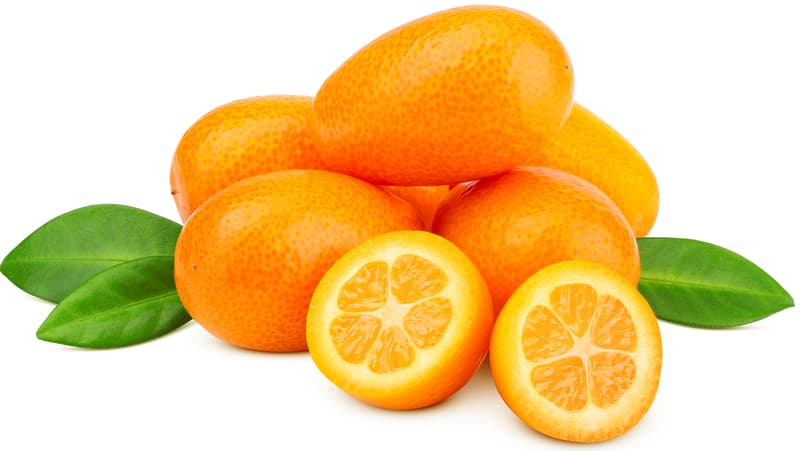
Kumquats loose
2,247 customers have this product in their favourites
32% of customers buy regularly
These Spanish kumquats, also known as dwarf oranges, are the smallest citrus fruits and are sold loose. They feature a thin, aromatic, and edible peel paired with mildly tart flesh, creating a wonderful sweet and sour contrast. Enjoy these untreated fruits fresh and whole, or use them to brighten up fruit salads, desserts, and homemade jams.
Similar products
Country of origin
Description
The kumquat, not uncommonly found as an ornamental fruit in our country, is the fruit of an evergreen, thorny shrub. The fruits look like small editions of oranges, but are a genus of their own. They are the smallest known citrus fruit of all, which is why they are also known as "dwarf orange". Their skin is thin and smooth, yellow to red in colour, aromatically fragrant. The skin of the kumquats is also edible. Together, the tangy sweetness of the peel and the slightly tart orange flavour of the pulp make for a most interesting savoury flavour combination.
Origin
An English botanist brought the kumquat to Europe in 1846. The fruit, native to south-eastern China and Indochina, grows wherever oranges thrive. However, it is mainly grown in China, Japan, North and South Africa, North and South America and in some Mediterranean countries. The season for kumquats is in the autumn and winter months. Deliveries reach us from Israel, South Africa, Italy, Morocco, Spain and Brazil.
Tips
Kumquats are sold untreated, so you can eat the peel - but washed - without worrying. Best eaten whole, but the first bite is very sour. Afterwards, you should chew the peel well, because this is where the essential oils are. The longer you chew the kumquat, the sweeter it becomes.
Preparation
Kumquats are usually eaten as a fresh fruit, including the skin and seeds. Kumquats are used in fruit salads, creams, desserts, pies, to garnish roast game and poultry, etc. Frozen, they can be added to mixed drinks instead of ice cubes. Further, the fruits can be made into compote, jam, marmalade, etc.