
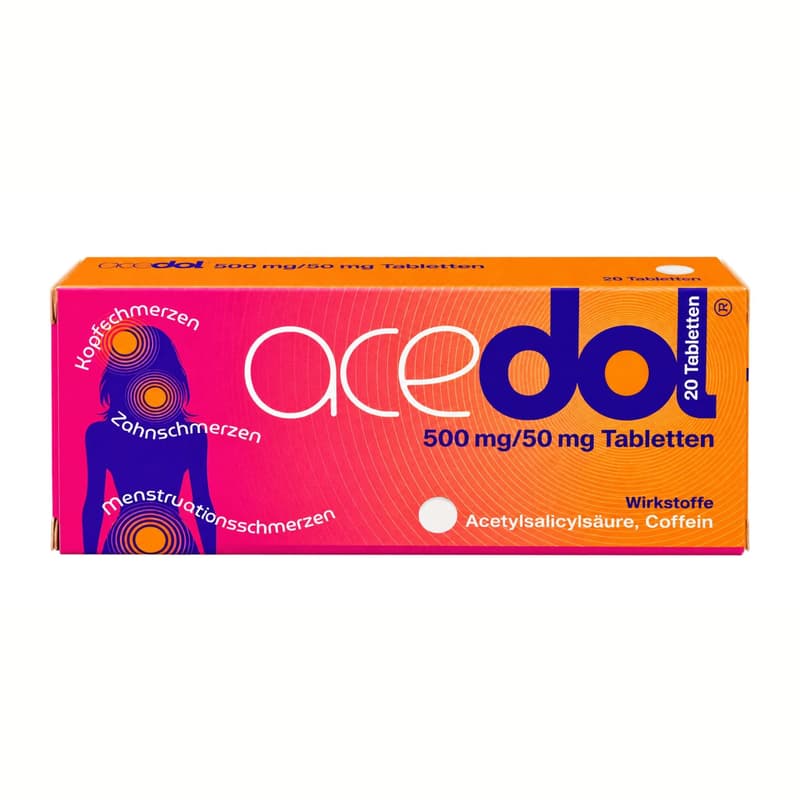
ACEDOL 500 mg/50 mg Tabletten
Only 9 items left
ACEDOL 500 mg/50 mg tablets combine acetylsalicylic acid with caffeine to help relieve mild to moderate pain, such as headaches, toothaches, or menstrual cramps. In this combination, caffeine enhances the pain-relieving and anti-inflammatory effects of acetylsalicylic acid. Available as a pharmacy product with 20 pieces, suitable for adults and adolescents over 16 years.
Dies ist ein Arzneimittel. Zu Risiken und Nebenwirkungen fragen Sie Ihren Arzt oder Apotheker. Wir stehen Ihnen gerne unter (+43 (1) 343 43 53) oder per E-Mail (gurkerl@beavit.at) zur Verfügung.
Similar products






Description

ACEDOL combines acetylsalicylic acid with caffeine in one tablet.
ACEDOL 500 mg/50 mg tablets are suitable for the short-term treatment of mild to moderate pain, such as headache, toothache, or menstrual pain. Each tablet contains 500 mg acetylsalicylic acid and 50 mg caffeine. Acetylsalicylic acid has an analgesic and anti-inflammatory effect; according to the package leaflet, caffeine enhances the pain-relieving effect.
Important for selection: Acetylsalicylic acid can increase bleeding tendency and is not suitable for everyone. In particular, ACEDOL must not be taken in the case of a current gastrointestinal ulcer, increased bleeding tendency, certain severe organ or cardiovascular diseases, during the last three months of pregnancy, or under 16 years of age. If taking regular medication, suitability should be checked in advance with a pharmacy.
How is it used?
ACEDOL contains a combination of two active substances: acetylsalicylic acid, which has an analgesic and anti-inflammatory effect, and caffeine, which enhances the pain-relieving effect.
ACEDOL can be used for mild to moderate pain, such as headache, toothache, and menstrual pain, as well as for inflammatory conditions.
If you do not feel better or if you feel worse after 4 days, consult your doctor.
What should you consider before taking it?
ACEDOL must not be taken if you
- are allergic to acetylsalicylic acid, other salicylates, caffeine, or any of the other ingredients of this medicine listed in section 6,
- have had an asthma attack in the past caused by salicylates or other non-steroidal analgesic and anti-inflammatory medicines,
- currently suffer from a gastrointestinal ulcer,
- have an increased tendency to bleed,
- have severely impaired kidney function,
- have severely impaired liver function,
- have severe heart failure or another cardiovascular disease,
- are receiving methotrexate treatment at a dose of 15 mg/week or more,
- are in the last 3 months of pregnancy,
- are under 16 years of age.
Warnings and precautions
Please talk to your doctor or pharmacist before taking ACEDOL,
- if you are hypersensitive to anti-inflammatory or anti-rheumatic medicines,
- if you are currently suffering from an allergic reaction, asthma, hay fever, chronic respiratory disease, or nasal polyps,
- if you are also taking blood-thinning medicines (anticoagulants, e.g. coumarin derivatives, heparin, except low-dose heparin),
- if you have a history of gastrointestinal ulcers or gastrointestinal bleeding,
- if you have impaired liver function,
- if you have impaired kidney function or a cardiovascular disease, as acetylsalicylic acid can further increase the risk of renal impairment and acute kidney failure,
- before surgery, including minor surgical procedures (e.g. tooth extraction),
- if you suffer from severe glucose-6-phosphate dehydrogenase (G6PD) deficiency, as acetylsalicylic acid may cause haemolysis (destruction of red blood cells) or haemolytic anaemia in this case. The following factors may increase the risk of haemolysis: high dose, fever, acute infection.
Do not continue taking ACEDOL to treat headaches caused by long-term use of ACEDOL, as this condition can become permanent.
The regular use of painkillers, especially taking multiple painkillers at the same time, is not recommended as it can lead to impaired kidney function and acute kidney failure.
In patients prone to gout (inflammatory arthritis), ACEDOL may trigger a gout attack.
This medicine contains caffeine. While taking this medicine, the consumption of large quantities of caffeinated coffee, tea, and some non-alcoholic energy drinks should be avoided. Excessive caffeine consumption can cause sleep disturbances, tremors, and chest discomfort (palpitations).
Children and adolescents
ACEDOL must not be used in children and adolescents under 16 years of age. In adolescents with fever, it may only be used after consulting a doctor and only if other measures have proven ineffective. Persistent vomiting may be a sign of a rare but life-threatening condition that requires immediate medical attention.
Taking ACEDOL with other medicines
Tell your doctor or pharmacist if you are taking/using, have recently taken/used, or might take/use any other medicines.
When taking ACEDOL at the same time, the effect of the following medicines is increased:
- some blood-thinning medicines (anticoagulants),
- other non-steroidal anti-inflammatory drugs (NSAIDs),
- oral steroids (except for hormone replacement therapy in Addison's disease),
- some medicines used to treat diabetes mellitus,
- methotrexate, which is used to treat autoimmune diseases and cancer,
- valproic acid for the treatment of epilepsy,
- digoxin, which is used to treat heart conditions,
- selective serotonin reuptake inhibitors (SSRIs) used to treat depression and anxiety disorders,
- certain medicines that stimulate the nervous system, e.g. some asthma and allergy medicines as well as thyroid hormones (e.g. thyroxine): increased risk of rapid heartbeat,
- ephedrine and other similar medicines (e.g. certain medicines for the treatment of colds and hay fever): increased risk of dependence.
When taking ACEDOL at the same time, the effect of the following medicines is reduced:
- some medicines used to treat high blood pressure,
- some diuretics (water tablets),
- sedatives (e.g. barbiturates, antihistamines),
- some uricosurics used to treat gout.
Interactions with caffeine:
- when taken in high doses together with certain medicines used to treat anxiety (anxiolytics, e.g. benzodiazepines), various unpredictable interactions may occur,
- oral contraceptives, some medicines for gastric ulcers (e.g. cimetidine), and disulfiram (a medicine used to treat alcohol dependence): these can reduce caffeine metabolism,
- some sedatives (e.g. barbiturates) and smoking increase caffeine metabolism,
- theophylline-containing medicines (medicines for bronchial asthma, bronchospasm): the excretion of theophylline is reduced; therefore, the risk of side effects increases,
- certain medicines used to treat infections (gyrase inhibitors of the quinolone carboxylic acid type) can reduce the excretion of caffeine from the body,
- medicines that enhance liver enzyme activity (e.g. some medicines used to treat epilepsy): they reduce the pain-relieving effect.
Taking ACEDOL with food, drink, and alcohol
The tablets should be taken with plenty of liquid (1/2 to 1 glass of water) or dissolved in water, preferably after meals.
Concomitant consumption of alcohol increases the risk of mucosal damage and gastrointestinal bleeding.
Pregnancy, breast-feeding, and fertility
If you are pregnant or breast-feeding, think you may be pregnant, or are planning to have a baby, ask your doctor or pharmacist for advice before taking this medicine.
You may only take ACEDOL in the first 6 months of pregnancy in justified cases if this has been agreed with your doctor. It must not be taken during the last 3 months of pregnancy.
During breast-feeding, it should only be given in particularly justified cases and at a lower dose than usual. If higher doses are required over a longer period, discontinuing breast-feeding should be considered.
There is some evidence that the mechanism of action of acetylsalicylic acid may impair female fertility. This effect is reversible upon discontinuation of treatment.
Driving and using machines
No effects on the ability to drive and use machines have been observed.
How should the medicine be taken?
Always take this medicine exactly as described in this leaflet or exactly as your doctor or pharmacist has told you. Check with your doctor or pharmacist if you are not sure.
The recommended dose is:
Adults and adolescents over 16 years of age: 1 tablet, which may be repeated every 6 hours.
The maximum daily dose is 3 tablets.
The tablets should be taken with plenty of liquid (1/2 to 1 glass of water) or dissolved in water, preferably after meals. The tablets should not be taken on an empty stomach and should not be used for longer than 4 days without medical supervision.
Use in children and adolescents
ACEDOL must not be used in children and adolescents under 16 years of age.
If you take more ACEDOL than you should
If you suspect an overdose, contact your doctor or a hospital immediately.
Symptoms of an overdose may include: headache, dizziness, hearing loss, ringing in the ears (tinnitus), confusion, convulsions, nausea, rapid breathing and heartbeat, chest pain, restlessness.
If you forget to take ACEDOL
Do not take a double dose to make up for a forgotten dose.
If you have any further questions on the use of this medicine, ask your doctor or pharmacist.
What are the possible side effects?
Like all medicines, this medicine can cause side effects, although not everybody gets them.
Common (may affect up to 1 in 10 people) heartburn, nausea, vomiting, abdominal pain.
Uncommon (may affect up to 1 in 100 people) hypersensitivity reactions, such as skin reactions
Rare (may affect up to 1 in 1,000 people)
- Hypersensitivity reactions can occur especially in asthma patients, with the following symptoms: high blood pressure, breathing difficulties, runny nose, blocked nose, disorders of the cardiovascular and respiratory systems, and in very severe cases a hypersensitivity reaction affecting the entire body (anaphylactic shock or angioedema),
- Stomach ulcer (in very rare cases perforation may occur), gastrointestinal bleeding with potential symptoms such as vomiting blood and black stools, inflammation of the stomach lining (gastritis). Long-term bleeding can lead to anaemia in rare cases.
- Severe hypersensitivity reactions, such as erythema multiforme.
Very rare (may affect up to 1 in 10,000 people)
- Elevated liver enzyme levels
In rare to very rare cases, brain haemorrhages have been observed, especially in patients with uncontrolled high blood pressure and concurrent use of blood-thinning medicines (anticoagulants). Haemolysis (destruction of red blood cells) and haemolytic anaemia have been reported in patients with severe glucose-6-phosphate dehydrogenase (G6PD) deficiency. Acetylsalicylic acid can increase the risk of bleeding, which may manifest as: subcutaneous bleeding (bruising), nosebleeds, bleeding gums, or bleeding from the urogenital tract. The increased bleeding tendency can persist for 4 to 8 days after ingestion.
Not known (frequency cannot be estimated from the available data)
- Insomnia, restlessness, irritability, headache, tremor of the hands, dizziness, confusion, hearing loss, ringing in the ears (tinnitus) (can also be a symptom of an overdose),
- Flushing, high blood pressure, palpitations, rapid heartbeat, cardiac arrhythmias,
- Impaired kidney function, acute kidney failure.
Reporting of side effects
If you get any side effects, talk to your doctor or pharmacist. This includes any possible side effects not listed in this leaflet. You can also report side effects directly via the national reporting system:
Federal Office for Safety in Health Care (BASG) Traisengasse 5 12
Composition & Allergens
Composition
Wirkstoff: ACETYLSALICYLSÄURE, COFFEIN
EAN: 09088886062924, 9088886062924
PZN: 6062924