We source locally for the freshest groceries you can trust.
- Description
- Composition
- Similar products
- More from this brand
- Recipes
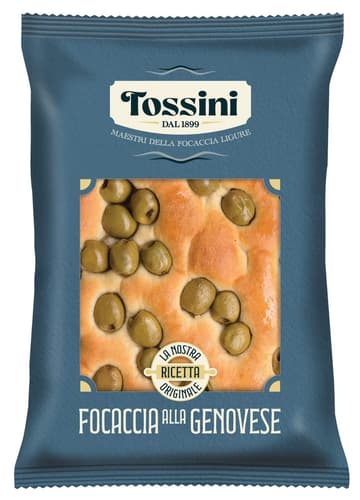
Tossini Focaccia with Olives
Focaccia genovese (in the Genoese dialect fugassa) is a symbol of Ligurian cuisine, loved and appreciated not only in Italy but all over the world. Focaccia is not just a recipe – it's a philosophy of life: it can be enjoyed at any time of day. It is common to eat a piece of focaccia with coffee for breakfast, dip it in a cappuccino, or enjoy it as a snack during the day.
The Focaccia Genovese is also a versatile ingredient that can be used in many ways. It can be filled with cold cuts, cheese, and vegetables to prepare delicious sandwiches, or served alongside soups and salads.
It is a yeast-leavened baked good, consisting of only a few ingredients: flour, water, oil, yeast, and salt. It is easily digestible, and the typical indentations, still made by hand, are a special characteristic of focaccia that the Tossini Bakery and Confectionery aims to preserve, guaranteeing consumers a quality product – as if bought from a local baker.

Preparation recommendation:
Remove the packaging and bake the focaccia at 200–220°C for 2–3 minutes or in a covered pan at medium heat for 4-5 minutes.
DID YOU KNOW?
The connection between Genoa and focaccia is so close and deeply rooted that it dates back to a very old tradition: from the Middle Ages through the Renaissance to its refinement with ingredients similar to today's, it took its current form in the early 19th century.
Focaccia has always been a central part of the Ligurian diet. In the Middle Ages, Genoa was one of the most important maritime cities in the Mediterranean, and focaccia was eaten not only by workers but also by merchants and nobles. Furthermore, travelers, sailors, and fishermen found this simple recipe – both in terms of ingredients and preparation – satisfying and easy to store during journeys and crossings, thus passing on a timeless heritage.
In the Renaissance, it was even customary to eat focaccia in church at weddings, drinking wine with it during the blessing. Apparently, this habit was so widespread that Bishop Matteo Gambaro had to threaten some monks with excommunication in 1500 if they did not stop consuming this "frugalia" or "pitanza" – which was probably so delicious that the faithful even shared it at funerals.
Documents from the 16th century also mention festive banquets in honor of the newly elected Doge, explicitly listing a "fugassa" among the dishes prepared for the feast.
In the 19th and 20th centuries, focaccia spread to other regions of Italy and even abroad, thanks to the emigration of Ligurians. In many countries, especially in South America and the USA, Focaccia Genovese became a symbol of Italian cuisine and was enthusiastically embraced by local communities.
During this period, several variants of Focaccia Genovese also emerged, some of which became equally famous. These include Focaccia with onions, which adds a sweet note and extra flavor, or Focaccia with Stracchino cheese.
Stracchino cheese comes from Lombardy, a region in Northern Italy. The name "Stracchino" is derived from the Lombard dialect word stracch, meaning "tired." The name refers to the tradition of making the cheese from the milk of tired cows after autumn grazing. This "tired" milk has a special composition that gives the cheese its exceptional creaminess and consistency.
Manufacturer:
Panificio Pasticceria Tossini S.p.A Via B. Assereto, 7 – 16036 Recco (Ge)- Italy

Durability
Focaccia mit Oliven
Zutaten: WEIZENMEHL, Oliven 31,5 %, Wasser, raffiniertes Sonnenblumenöl mit hohem Ölsäuregehalt, natives Olivenöl extra, Hefe, Salz, Malzextrakt (GERSTE, Mais), Aromastoffe.
Im Kühlschrank zwischen +0°C and +4°C lagern. Für den direkten Verzehr geeignet oder wenn gewünscht, im Ofen erhitzen.
Nutritional values per 100g
| Energy value | 1333 kJ/318 kCal |
| Fats | 15.7 g |
| including saturated fatty acids | 2.2 g |
| Carbohydrates | 37.8 g |
| including sugars | 0.9 g |
| Protein | 5.2 g |
| Salt | 1 g |
| Fibre | 2.6 g |
Allergens
| Cereals (gluten) |
| May contain traces of: |
| Eggs |
| Fish |
| Soybeans |
| Milk |
| Tree nuts |
| Mustard |
| Sesame seeds |